

Friday, December 19
Grand Rapids, Mich.
I got home late last night from a reporting trip in Bahrain for Travel+Leisure. My suitcase, however, has apparently decided it prefers Middle Eastern warmth to West Michigan’s cold and snow; it’s still in Dubai, though I hope for a reunion at some point in the near future.
Among the things I managed to bring home with me: Dubai chocolate (never had it, so I’m curious whether it will live up to the hype) and fond memories of conversations with wonderfully hospitable Bahrainis. Never have I experienced such welcome. At one coffee shop, the proprietor refused payment, because it was my first visit to Bahrain. At lunch one day, I went to pay, only to learn that a stranger had bought my lunch; she recognized me from an Instagram post by my tour guide, the inimitable Husain Alhabib.
My two-and-a-half days with Husain were rich and unforgettable. While the story I’m working on isn’t about religion, I’ve learned that, especially when reporting outside the U.S. or Europe, if I spend enough time with someone, faith inevitably comes up. In Bahrain, as elsewhere in the Middle East, conversation is peppered with the phrases inshallah (“if God wills”), mashallah (“as God has willed”), and alhamdulillah (“Praise be to God”). Sometimes things go deeper, as they did with Husain.
Somehow he intuited my interest in matters of faith and spirituality. Last Saturday, he took me to the synagogue in Manama, Bahrain’s capital, even though it wasn’t on our itinerary. But before we went in, he stood me on a street corner outside. “There is the Jewish synagogue,” he said. He slowly shifted my gaze, pointing out minarets: here, a Shiite mosque with elaborate tilework on its facade, with a mainly Iranian congregation; there, another Shiite mosque, plainer, more for Bahrainis. At the end of the road was a grand Sunni mosque. Around the corner, we’d passed a Hindu temple. A short walk away, the Anglican cathedral and a Catholic church. “Nobody can stop anything or anyone from God,” he says. “Religion—any religion—is a practice guiding you to God.”
Inside the synagogue, we found more signs of ecumenism. Husain greeted the caretaker, a Christian with Indian roots, and asked if there had been enough Jews to make a minyan at that morning’s services. “Just one,” the man said. “I don’t know why.” Jews have played a prominent role in Bahraini society—Houda Nonoo, who hails from a prominent Jewish Bahraini family, served as Bahrain’s ambassador to the U.S. during the Obama administration, the first Jew from an Arab country in such a role—but only a few dozen remain in the country.
Husain grew up in Samahij, in the north of Bahrain. Samahij has millennia of history buried in its soils. Try to dig a foundation to build something new and you’ll inevitably hit something old. Some years ago, residents decided to construct a new mosque on a site where the old folks in town said there had once been one. As soon as work began, pieces of coral stone, detritus from some fallen building, were found. The builders called the Ministry of Culture, which sent archaeologists. Their dig uncovered the foundation of that old mosque—not a surprise—but then “they went deeper,” Husain said. “They found a Christian church.”
Dating of wood remnants and ceramic shards found that the church had been in use in the pre-Islamic era, roughly from the mid-400s. Plaster crosses suggested that the church was Nestorian. Other finds—carnelian beads, wine glasses, copper coins—hinted at wealth, leading the archaeologists to hypothesize that this complex might have included a bishop’s palace, because ancient documents record a bishopric in Mashmahig, an old name for Samahij. None of this surprised the locals. “We’re proud we were Christian before we were Muslim,” Husain said. “So, no need to build a new mosque there.” The archaeological site is now being preserved and a museum planned.
Husain always had a string of prayer beads with him, and later that day, as we were in the car riding around town, I asked about them. They were golden agate, from Yemen. He bought them online. Out of curiosity, he took them to a jeweler in Bahrain one day and was quickly offered a price 50% higher than he’d paid. Of course he said no. He just wanted to know.
To him, the prayer beads carry so much meaning. They remind him of how his father taught him to pray when he was 7. And whenever he holds them in his hands, which is most of the day, every day, he feels more connected to God. I asked whether he heard anything from God in reply. “I don’t hear, but I feel something, like God is talking to me,” he said. I asked what he prayed about. “I don’t complain to my wife, I don’t complain to my friends, but I complain to God. Why would I rely on humans? Everything is in God’s hands,” he said. “I tell him what I want, what I feel, what I wish. It’s a practice, but it’s not just a practice—it’s connection.”
The Arabic word salah means “prayer,” but its root, silah, means “link” or “connection.” The five daily prayers mandated by Islam are meant to maintain regular communication. For Husain, his beads augment the practice.
I thought about my own inconsistent prayer life. Last month, I led a Bible study on prayer, because I know I’m not alone in my struggles to find the right words to talk with God. But let us not even speak of how often I think I hear from God, except to say that the download speeds seem slow. Maybe, though, God can still reach me through unexpected teachers.
Islam teaches a particular humility that confesses the ultimate inability of the human to fully understand God. The churches I grew up in never acknowledged that kind of divine mystery. Instead, we were taught to act with the certainty of insight into the divine, which we then had to use to persuade others. It struck me that Husain seemed uninterested in evangelism or persuasion, though he was glad to give testimony.
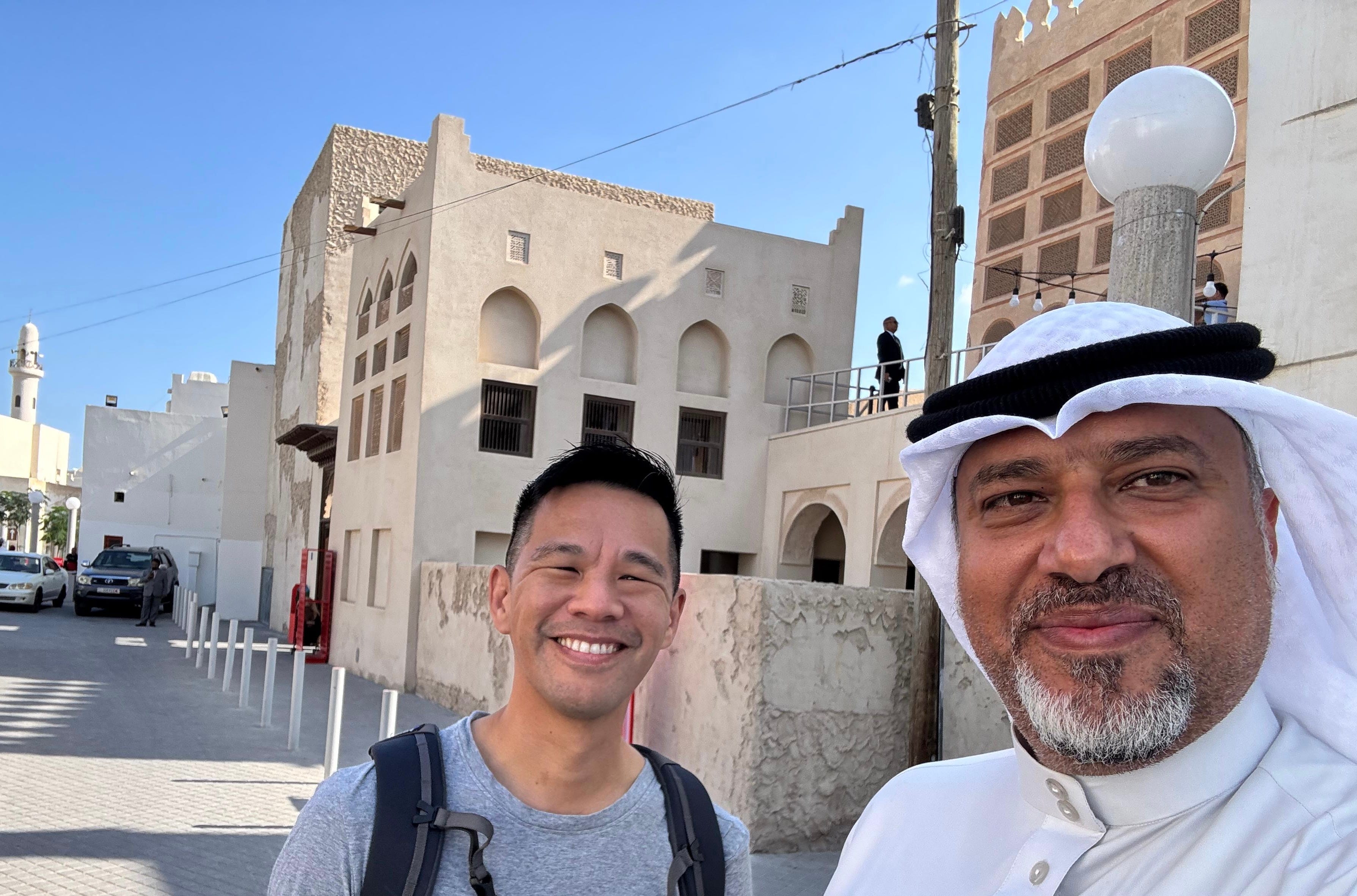
“Our religion asks us to be good, which I think is the same whatever your religion. The practice may be different, but it is the same,” he said. “God is for everybody.” He paused, then looked at me and smiled. “We will meet again in paradise, me and you, inshallah.”
Here’s a prayer I can say wholeheartedly: God, I hope that happens.
It’s the time of year when list after list comes out declaring which books were the “best.” Honestly it makes me cranky. I bristle every time I see a headline that says “best books.” What does “best” even mean? Did the judges really read every single published book? Impossible.
Some honest reviewers have made lists of their favorite books of the year. That feels more honest to me. So here are my favorites—not all of them are new—with very short reviews, in no particular order, because it’s a fool’s errand to try to rank.
All These Ghosts (2025), Silas House - poignant poetry, exuding love for land and people
Beard: A Memoir of a Marriage (2025), Kelly Foster Lundquist - the funny, honest, brave recounting of a marriage to a gay man
Kitchen Hymns (2025), Pádraig Ó Tuama- enchanting, thoughtful poems about life, belief (or unbelief), and meaning-making
Qui a tué mon père? (Who Killed My Father?) (2019), Edouard Louis - the story of a father and a son, social inequality, fracture and healing
In Kiltumper: A Year in an Irish Garden (2021), Niall Williams and Christine Breen - gentle and gorgeous
The Place of Tides (2025), James Rebanks - a transporting and revelatory book about a dying way of life (I wrote a longer piece about my love for this book)
The Cooking Gene (2017), Michael Twitty - moving memoir + rich culinary history
Little Mercy (2025), Robin Walter - graceful poetry—who knew I’d ever read so much poetry?—about nature, grief, and love
The Cook’s Garden (2025), Kevin West - a lush wonderland of recipes and gardening advice
For the most part, these are relatively quiet books, written with restraint. Every one of these writers is awesomely curious and perceptive, exploring both the inner life and the outer world with thoughtfulness and care. I don’t think I’ve seen the 2025 publications on many “best books” list. Why?
Tell me about your most memorable reads of the year, whether old or new.

A package came from my publisher recently. Turns out they had a few leftover promo boxes with copies of Good Soil. So I thought I’d do a little giveaway. If you know someone who would enjoy Good Soil—someone who is not yourself, please—send me an email at makebelievefarmer@gmail.com, tell me a little about them, and let me know why they’d welcome a surprise gift in the mail. Deadline: December 31st. I’ll pick five recipients and send the books off to them with a note of encouragement.
I got some quibbles in response to my last letter, in which I said that every human is a beloved child of God. While these folks would concede that every human is made in God’s image, some literalists argue that, in the New Testament, “child of God” refers to the believer, to the faithful, to the one who walks in the ways of God.
I’m no literalist. I also believe all human language, even the biblical, which is to say the God-inspired sort, can only partially explain divine things. The phrase “child of God” deploys metaphor for the sake of mapping relationship. It’s imperfect. It’s figurative. But even if one holds to a more restrictive view of the family of God, it still doesn’t justify calling another human “garbage.” To say who is or isn’t a child of God seems a compelling activity to many, but it’s uninteresting to me—and even potentially dangerous, tempting us to claim to know things we can’t know. Beyond that, another’s spiritual status has no bearing on our call to love.
Then there were those who said something along the lines of, But you didn’t say anything when Joe Biden called millions of people garbage. Anyone who knows me knows that I am fiercely nonpartisan, and a critique of a not-good thing stands whether or not the critic critiqued a previous not-good thing. But such whataboutistic rebuttal makes me curious: What bubbles from the deep well that compels someone to respond this way? Is it hurt? Is it anger? Is it something else?
Finally, one person asked, “Who are the enemies you’re talking about?” I’ve thought a lot about who my enemies are. In Good Soil, I write about my struggles with my body—and I recognize that sometimes I’m my own worst enemy. I also don’t know the guy, and this was on Facebook. So I responded by saying, “I don’t know you, so I’m not sure I’m comfortable naming them, except for one. Sometimes I consider myself my own worst enemy and I struggle with loving myself, so there’s that.” It wasn’t the answer he was looking for. “If that’s the case,” he replied, “then I definitely think I am your enemy.”
OK, I guess?
Anyway, I can’t believe God would chide us for an overly lavish welcome, and I don’t think we’re anywhere near erring on the side of excessive generosity. If God is disappointed in us because our arms are too wide-open, then let me run risk that disappointment. God knows I’ve disappointed God in much less noble ways.
Programming notes: I’ll be preaching this Sunday, the last of Advent, at First Presbyterian Church in Berkeley, California, where I serve as parish associate for storytelling and witness. I haven’t finished the sermon, but the texts—on Bathsheba, as part of an Advent series on the women in Jesus’s genealogy in Matthew—are something else. Nothing like a little murder, patriarchal erasure, and predatory behavior to usher in Christmas cheer.
On the morning of January 11th, I’ll be at Church of the Savior in South Bend, Indiana. I’ll be preaching, and during the adult-education hour, I’ll give a talk entitled “Here I Raise My Ebenezer: On Beauty, Recognition, and Piles of Rocks.”
Next month: Brisbane, Australia! I’ll be visiting Baroona Farm, a wonderful little project on the grounds of St. Francis College that exudes Farminary vibes. On Saturday, January 31, there will be workshops—one on composting, one on recycling, another that I’m told involves Champagne?—and a potluck meal and a little talk that I’ll give at some point about Good Soil. On Sunday, February 1, I’ll be preaching at Kenmore Church. We’ll have brunch together afterward, and then there will be a live recording of the “On the Way” podcast, which is produced by the team at St. John’s Cathedral in Brisbane; recent guests have included Iain McGilchrist, Wil Gafney, and Pádraig Ó Tuama, so I really need to think of something helpful and intelligent to say.
Thanks to the lovely Jeremy Greaves, Archbishop of Brisbane, for the invitation. And if you’re in or around Brisbane then, I’d love to see you there.
Well, I think that’s more than enough for one letter.
I send this with my best wishes for a meaningful Christmas. Whatever you carry into the holiday, may you be met with good news and may you find hope and possibility in the strange old story of a squawking baby.
Yours,
Jeff
What a compelling story of you and your guide in Bahrain. Feels blessedly non-tribal, like the way life and religion should be.
I loved this Jeff! We are so much more alike than we are different… God is God no matter what we call him and he does want us to be good to one another. Merry Christmas to you and Tristan and thank you for always filling my mind and heart with goodness.