
Here, There, and Everywhere
Some fragmented thoughts on why we travel, spirituality and hospitality, that time I thought I was being poisoned by an elderly Czech lady, and loving the world

Sunday, July 19
Grand Rapids, Mich.
Why do you travel?
For a long time, I traveled because I was trying to escape.
Immersed in another culture, surrounded by the unfamiliar, I somehow found more peace than I could at “home.” Whether being taught to eat with my hand by my host family in Ghana (“not that hand—that’s for dirty things!” my host mom yelled when she saw me approach the fufu with my left), or clambering over ancient ruins on the West Bank, or backpacking across Zimbabwe, I never felt out of place—or perhaps I should say I felt appropriately out of place.

With no expectation of belonging, no pretense of home, I told myself I was liberated from any need to fit in. Especially as a young reporter, working at a magazine where writing in the first person was largely forbidden, I chased new adventures and others’ stories.
Except that those turned out to be narcotics—and I became a cliche: No matter how lightly I packed, I always had the same baggage. “No matter where you go,” the great philosopher Buckaroo Banzai said, “there you are.”
--
Earlier this week I was in New York City, for Travel+Leisure’s annual industry conference, the World’s Best Summit. On Tuesday afternoon, I moderated a panel about the place of spirituality in travel. The session was entitled “Seeking More.”
“Enduring hope, profound longing, the possibility of flashes of beauty, the reality of grief and disappointment and pain,” I said, introducing the panel. It was the day before England’s World Cup semi-final against Argentina, and I was wearing my England jersey. “This is what it means to be an England supporter,” I said. “But it’s also the reality of the human experience.”
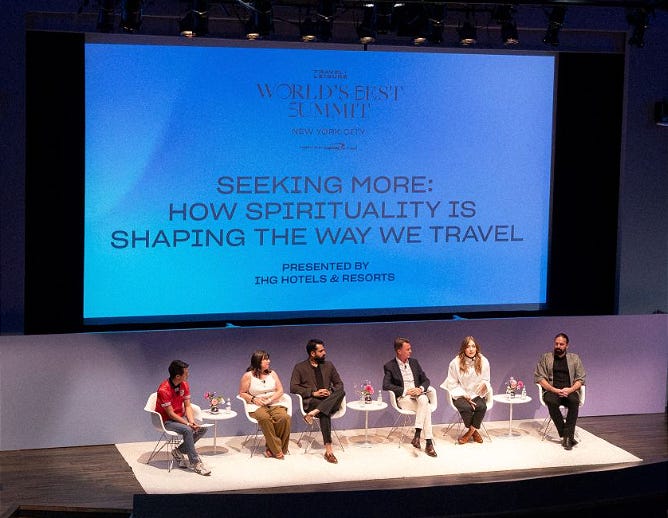
Over the next 35 minutes, six of us onstage—a hotelier, a writer specializing in wellness, a reporter who studies the contours of belief in our times, a human-rights lawyer turned travel adviser, a doctor, and me—explored our propensity to seek transcendence and our quest to find connection. We chose to define “spirituality” broadly, including, but not restricted to, religion. While pilgrimage is one of the most venerable genres of travel, you might find your mecca outside of Mecca, and your camino might not necessarily be the Camino. You might nurture your spirit at a wellness retreat or at a concert. Your cathedral might have the redwoods’ canopy as its roof, or maybe it’s a stadium, as you chant and sing your football team’s liturgy with 50,000 others.
I started the session by asking them each to name a trip that had been transformative for them.
Tom Rowntree, an executive at IHG Hotels & Resorts, recalled traveling to Poland as a teenager, not longer after communism’s fall; the generosity he experienced from his host family changed the course of his career and his life. New York Times reporter Lauren Jackson, who writes its (mostly) weekly “Believing” newsletter, spoke of studying abroad in Jerusalem; reared in the Church of Jesus Christ of Latter-Day Saints, she had an unexpectedly clarifying encounter with an Orthodox Jew, during which they confessed to each other that they no longer held the beliefs of their families of origin. Travel adviser Mark Lakin discussed a trip to the Democratic Republic of Congo, an atypical tourist destination usually described as “war-torn” or “dangerous”; there, he found that flattened narrative complicated by resilient life, soul-expanding generosity, and extraordinary welcome in Congolese homes and kitchens.
In all these instances, someone else’s hospitality opened up something new—growth, respect, even something approaching wisdom. That seems fitting for the word “hospitality,” which has the same Latin root as “hospital,” “hospice,” and “hotel.” Hospes can mean both “guest” and ”host.” Taken together, all this hints at not just a dance between giver and receiver but also the possibility of healing through relationship.
--
Because I was moderating, I didn’t answer my own question onstage. If I had, I might have told a story from my own study-abroad experience, in Brussels, when I was 19. During spring break, my friend and housemate Sara, who was in the same program, and I used our Eurail passes to head east.
We arrived in Prague with no place to stay and not a word of Czech between us. This was before the era of mobile phones or Google, and we figured we’d find some tourist-information booth where we could ask for help. But we arrived after dark. Everything was closed.
An elderly woman approached us in the central station. “Hotel?” she said. For reasons still unknown to me—maybe call it exhaustion or foolishness or desperation—we went with her.
Her apartment, right on Wenceslas Square, in the heart of the city, might once have been described as gracious, even elegant. She motioned for us to drop our backpacks and sit on the sofa. Then she asked, in broken English, if we wanted some tea and something to eat. While she was in the kitchen, Sara and I launched into a furious but whispered conversation: Was this safe? Were we insane? What was happening?
The lady emerged a few minutes later, setting cups of chipped china, along with some biscuits, on the coffee table. I sniffed the tea; it smelled like strawberries. She smiled at us, and waved, urging us to drink and eat.
My lizard brain has always slithered to the nearest, most ridiculous worst-case scenario: Doesn’t cyanide smell like strawberries? I took the tiniest sip. As soon as the lady left the room again, I said to Sara: “Doesn’t cyanide smell like strawberries? What if she’s trying to kill us?”
Cyanide does not smell like strawberries—it smells like almonds—but again, this was pre-Google. Marie Svoboda was not out to kill us. She was just trying to survive.
Over the next couple of days, we learned she was a widow. Her husband had been an actor—a handsome one, we could see, from the framed portrait she pointed out on the wall. The tenderness on her face when she spoke of him told us that theirs had been a great love story, even if we didn’t have the shared language to receive all the details.
Her pension and the remnants of his didn’t provide enough to live on. When money ran low, she’d walk over to the train station to study the waves of backpackers disgorged by the trains. She read their faces as quickly but carefully as she could, trusting her intuition to identify someone who seemed trustworthy enough to invite into her home.
Vulnerability, openheartedness, the capacity to walk through discomfort, the patience to listen, the willingness to learn: Perhaps these are prerequisites for hospitality that transforms, no matter whether you’re guest or host.
It also wouldn’t hurt to assume that not everyone is out to kill you. I suppose it’s worth mentioning that “hostility” also shares the same root as “hospitality,” which is to say, we do have some choices to make.
--
My favorite travel writer of all time might be the late Polish journalist Ryszard Kapuściński. In his book Travels with Herodotus, he muses on what compelled the ancient Greek historian to crisscross the ancient world, gathering myths and stories. Eventually, Kapuściński concludes that it must have been some insatiable longing to know both the world and himself better. “The man who ceases to be astonished is hollow, possessed of an extinguished heart,” he writes. “If he believes that everything has already happened, that he has seen it all, then something most precious has died within him—the delight in life.”
I used to travel because I was trying to escape. Now I think I travel because I want to keep being astonished by the world. And while I know there is still so much to see, and to feel, and to taste, and to learn, I also think my desire goes beyond the delight that Kapuściński describes: I want to know how to love the world more fully, and those who love always want to know more about those they love.
I love the world in all its gorgeous diversity, and I want to know more about that world. I want to know its sorrows as well as its joys, its struggles and its triumphs. That’s undoubtedly why I feel so lucky to be a travel writer, because I get to write love letters about the places I go and the people I meet and the things I eat.
My religion teaches that we know how to love because we have already been loved. To let yourself be loved—by anyone, by the world, even and especially by a stranger!—might be the hardest thing to do. Anyone who has loved and been loved knows that love is risky. It opens you up to disappointment, and sometimes you might even get hurt. Ultimately, though, I suspect it’s the only way we’ll ever find the “more” we seek—fulfillment, flourishing, wellness that becomes wholeness.
No matter where you go, there you are, it’s true. But where there’s love, we’ll find home.
I’d love to hear about your summer travels. Where have you found astonishment? Where have you felt loved, perhaps unexpectedly? Who has shown you some sense of home? Let me be clear, too: “Travel” doesn’t require getting on an airplane or going very far. Curious travelers can make quite the journey even while staying in the city where they live.
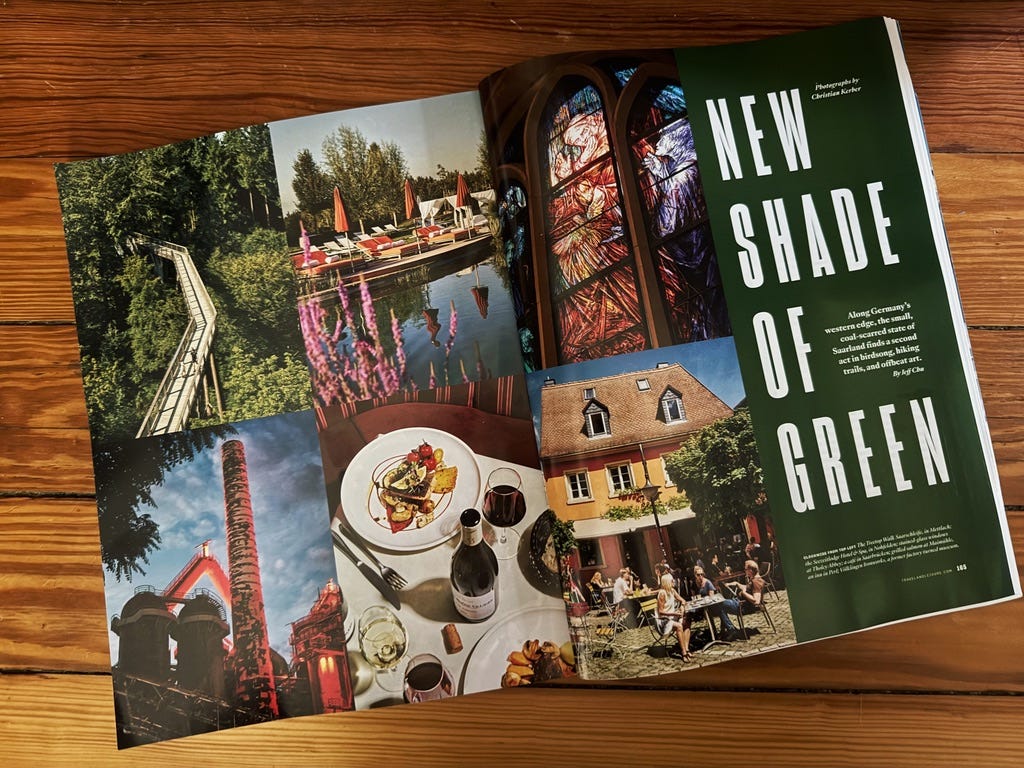
My latest story for Travel+Leisure, about Saarland, Germany’s least-visited state in Germany, is in the magazine’s August issue, on newsstands now. (You can read a version of the story online here, but because I am old-school, I will always believe it’s better in print.)
That’s all for this week.
I’m writing you a little less often as I push to finish my PhD dissertation this autumn. Thanks for your patience—and, as always, for walking alongside me on this journey.
Yours,
Jeff
As residents of Los Angeles, my husband and I are working our way through exploring the California coast together, whenever we get time off. Once in Santa Barbara we stopped to talk to a man who was playing piano in the downtown area off State Street. He poured his heart into each tune and within the conversations we shared, a stranger we came to look for every time we came to the city. A top tier joy of mine is swapping stories with newfound friends, determined to bear witness to each other, with abandon and little expectation of ever seeing each other again. We become angels in disguise, just what the other needs in moments we can't even realize.
Thanks for this, Jeff.
For me, yesterday, traveling meant doing something I love but haven’t been able to the past few weeks: bicycle down the ravine path in our city. I have been doing a temporary job that involved a level of bureaucracy that seeped into into and looped dreams, that (dream and work) had the claustrophobic feeling of a Kafka story.
The ravine path is lush now; the silence of bicycling on my own power, and being able to breath after a week of smoke-filled atmosphere was intoxicating. Then I stopped where the river’s shallow water falls over a barricade to create a short falls. There, not 10 feet away from me was a blue heron, stock still in its leaning over the falls, its long beak pointed: intent. Once every 3-4 minutes, a flash and the light would catch the small fish wriggling off the beak tip, and down its gullet it disappeared. I felt as if I had entered a different time zone.