
Surrender to Love
Some fragmented thoughts on a conversation with a dying friend and his reflections on hope, acceptance, and gratitude

Monday, March 9
Grand Rapids, Mich.
If you knew your time on this earth was drawing to an end, what would you do? What choices would you make? How would you spend the rest of your days?
My friend Tony Vis, a retired pastor in Iowa, is dying. For the past few months, he has been in hospice care. Recently, I asked if he might be willing to talk—to share some wisdom and offer some reflections about walking through this stage of life.
—
Some backstory: Tony was diagnosed with lymphoma five years ago. His doctor prescribed six rounds of chemotherapy. “The third round almost killed me,” he said. An MRI showed a surprise: The cancer was gone.
Then, last summer, he started feeling unwell—tired, a little breathless. Scans and a biopsy confirmed that the cancer was back.
Option 1 was to retry the chemo regimen that had sent the cancer into remission the last time, but given that the treatment nearly ended his life, it seemed unappealing. Option 2 was another type of chemotherapy, though one that had been shown to be less effective against this type of cancer. Option 3: no treatment and hospice care. His doctors guesstimated that would give him six months, “but it’s all a guessing game, and six months, I’ve learned, is a standard one for them.”
“I was ready to go with hospice immediately,” Tony told me. “I was there, but we weren’t there.” His family wasn’t ready to let go. “Their voices mattered to me, and their needs matttered to me.” So he said yes to Option 2.
A turning point came one night last fall, when Tony woke up vomiting blood. He fell almost immediately after getting out of bed. His son Andy was staying with him that night. “He had to pick me up. And then my daughter—she’s a doctor—she came over, and they called 911,” he said. “We had to go on that journey together. We had to accept it together.”
Turns out it was mainly the chemo, not the cancer, that was hurting him at that point. His body rallied after a few touch-and-go weeks of recovery: “I’m feeling good now. Wondering when that will change, of course. The cancer is still there, and sooner or later, it’ll start to bite me.”
I asked if he was planning to pull a Jimmy Carter and be in hospice for years.
“I’m open to that,” he said, laughing. “I’ve said to God that I don’t expect a miracle, but I’ll take one. You’ve just gotta be open to these things.”
—
Some more backstory: Tony and I first met in 2014. The question of LGBTQ+ inclusion was roiling our denomination, and a small group of people with diverse convictions gathered in Grand Rapids for a couple of days of candid conversation and facilitated listening.
In 2015, a larger group convened, tasked with mapping out a way forward for the denomination. I was one of the few queer representatives. Tony, a past president of our General Synod, served as one of the conveners.
That same year, I’d started to think about the possibility of attending seminary. Though I still didn’t know exactly where Tony stood on LGBTQ+ inclusion, I asked him to be one of the five members on a discernment team, helping me to talk through my sense of call. He said yes, and over the subsequent months, we spoke regularly. He brought his decades of pastoral experience to our conversations, probing and questioning and giving me plenty to consider.
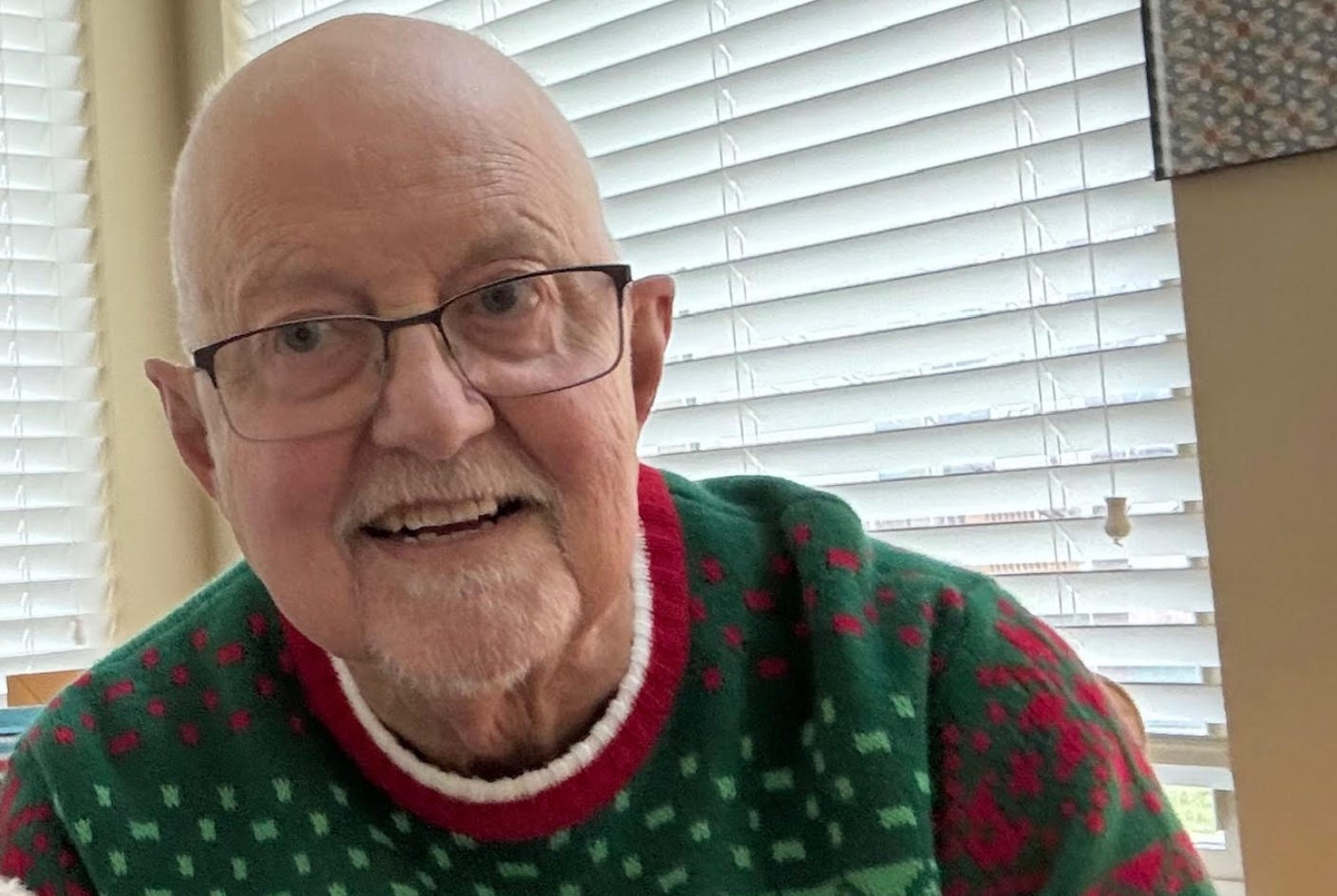
When we spoke last month, I told Tony I’d suspected when we first met that he was more conservative than me—and he hadn’t said anything back then to convince me otherwise. Only years later did I understand him to be on the side of full inclusion of LGBTQ+ people in the Church. “You know, I was then pretty much where I am now. But I hadn’t come out and said it as vocally and publicly,” he said. “Even before retirement, I was there. I’d been there, for a long time.”
He’d never been a biblical literalist. “My method of interpreting the Bible was always that it needed context,” he said. He’d been taught that in seminary. “But understanding the ancient culture and the ancient context—that became more and more important to me. And I knew that what was happening to the LGBTQ community was wrong. Paul didn’t know then what we know now. But I probably knew what I believed for twenty years before I really opened up.”
But why didn’t I know? Why wasn’t it clear? “I lacked the courage,” he said bluntly. “I just lacked the courage.”
While he was still serving as a pastor, he feared splitting his congregation. He feared losing his job too. “I wish I’d had the balls to do it,” he said, not least because he recognizes how his choices must have caused pain to queer people in his congregation. “I was late to this. I don’t hide that. And I repent of what I’ve done. I’m sorry.”
—
Tony’s body is failing him now, and I wondered how he regards his body, given the cancer. How do you love a body that is letting you down? “I’ve had to remember that I’ve had 79 years in this body, That’s pretty good,” he said. “Also, the best weight-loss program out there is chemotherapy.”
“That’s really dark, Tony,” I said.
“We’re okay with gallows humor around here—and it happens to be true,” he said. “I look at the inevitability of where this journey is leading, and that is to the end of life.”
He has accepted this ever since his first round of chemo, in 2021, when the side effects were keeping him up at night. “I just looked up at the ceiling, and I remember saying to God, I’m going to die—and I want to die. I actually said it twice. I want to die.” Then a portrait of his entire family came into focus in his mind. “And I immediately said, I don’t want to die.”
I wondered whether, as a longtime pastor, his convictions about the afterlife were any comfort. “This Jesus story has been a part of my life for as long as I can remember. So I live with that story, with the hope of resurrection. But, you know, I don’t know that for certain anymore—and that’s why we call it faith. I don’t know if there’s anything I know with certainty about what’s beyond this life. Maybe I’m supposed to as a Christian, but I don’t.”
His candor about his lack of certainty surprised me.
“I have faith there is something beyond this. I look at this amazing universe, and it’s so beautiful; when we get to see it through the telescopes they’ve got out there, it’s so beautiful,” he said. “There’s got to be love behind that beauty. So I just see death as a surrender to that love.”
Over the decades of his ministry, he lost count of how many babies he baptized. Every single time, after sprinkling the water on the baby’s head, he would say the child’s name aloud and declare, “You belong to Jesus. He will never let you down and never let you go.” “I believe that, and I’ve had to remind parents from time to time, God hasn’t given up,” he said. “I don’t know what that looks like. And we all sometimes feel let down from time to time, but I have to look back and believe that somehow, God was there. And I go into this part of the journey believing the same thing. This isn’t a letdown. It’s a ‘let-go,’ but it’s not a letdown. Death is a part of life.”
Tony reiterated that he was not and is not afraid of death. “You know, dying isn’t a problem for me—leaving is the problem,” he said. “Leaving is the issue. Leaving my wife of 57 years behind. Leaving my children. Leaving my grandchildren and not being able to see them grow up.”
In November, when the family thought he had little time left, one of his granddaughters moved her wedding up so that he’d be able to preside. “I was there in a wheelchair, I was not doing well, and I can tell you, it’s the first and only wedding I’ve ever done wearing a diaper. That’s how it was,” he said. “But we did it, and that was so, so good.”
He also got to see one of his sons open a new restaurant recently. “That’s been a beautiful thing to watch,” he said. The restaurant, Zeke’s, in Johnston, Iowa, serves pizza, among other things. Some years ago, Tony and his kids and grandkids were on vacation in St. Joseph, on the Lake Michigan shore, and they stumbled across a kiosk that had an oddity on the menu: pot roast pizza. Tony’s dad, Peter, had always loved pot roast—“he always said, ‘Just give me pot roast, mashed potatoes, and corn, and I’m fine”—so when Zeke’s opened, there it was on the menu: Peter P’s Pot Roast Pizza.” (The pizza has all those toppings as well as another called jalapeño tater kegs, which is an arrangement of words I do not understand.)
“By the way,” Tony added, “I get a discount at the restaurant. A really big discount.”
—
Something of a three-point sermon emerged in our conversation, because a retired pastor is still a pastor. First, hope—not certainty, but hope. (“How many Easters did I preach? How many resurrection sermons? How many funerals where I spoke words of comfort to a family and reminded them of the resurrection as we stood at a gravesite?”) Then acceptance. Finally, gratitude.
The gratitude in particular has inspired a strange freedom over the past few months of extended farewell. Before Christmas, Tony had at least one visitor almost every day. “Everybody figured I’d be gone soon,” he said, “so they thought they were saying goodbye.” It’s been a little awkward to see some of those same folks since. “It’s like, What’s he doing here still?”
What he’s doing is planning for the future. “I really planned on living to 90,” he said, “but the engine doesn’t seem to want to go that long.”
He did make it to his 79th birthday, on February 26th.
He has his funeral all planned out. The congregation will sing “Be Thou My Vision.” One of the readings will be Psalm 46 (“God is our refuge and strength, a very present help in trouble...”), just as it was at his grandfather’s funeral in 1970 and his dad’s funeral in 2007.
He has chosen as the closing hymn “God of Grace and God of Glory.” It was written during the Great Depression by Harry Emerson Fosdick, who had been a chaplain during World War I and then became the first senior minister of the Riverside Church in New York City.
The third stanza of the hymn, which was written for the dedication of the Riverside Church’s Rockefeller-funded building in 1931, goes like this:
Cure Your children’s warring madness;
Bend our pride to Your control;
Shame our wanton, selfish gladness,
Rich in things and poor in soul.
Grant us wisdom, grant us courage
Lest we miss Your kingdom’s goal,
Lest we miss Your kingdom’s goal.
“It speaks to the time we’re in, and I’m not going to leave without making this point,” Tony said. “We’re at the messiest that our culture, our society, our government, the Church—the big-c Church in America—has been in my lifetime. And I would say to the Church: You’ve lost your way. You think the way of the kingdom is just to get people to pray the Sinner’s Prayer and that’s the end of it? That is not the way of the kingdom.”
He’s currently reading one of James Patterson’s Alex Cross books (“it’s just fun”). He quit taking his heart medication (“one of them is really freaking expensive, so why spend the money?”).
Next week, he’ll fly to Arizona with his wife, their daughter, and their daughter’s family for spring break. “First time ever I bought the insurance for the flights,” he said. “Without the insurance, if we didn’t go, I’d get credit, but the credit wouldn’t do me much good.”
There they are again—hope and acceptance, quickly followed by gratitude. “Every day I get is a gift,” Tony said. “I’m grateful for it, and I’m trying to live it with joy.”
Calendar notes: This Saturday, March 14th, I’ll be speaking at the public library in Cranbury, N.J. And on Sunday the 15th, I’ll be preaching both services at Burke Presbyterian Church, in Burke, Va., then speaking at the church in the evening.
Next Sunday, March 22nd, I’ll be preaching at Second Reformed Church in Zeeland, Mich., and we’ll talk about Good Soil during the adult-education hour.
And on Palm Sunday, March 29th, I’ll be back in North Carolina, at Crosspointe Church.
Hope to see your friendly faces somewhere on the road.
In closing, here’s a glimpse of glory, from Ocean Beach in San Francisco, where I whiled away a good hour yesterday afternoon.

I’d love to know where you’re finding beauty and goodness in the midst of the mess of the world.
With hope and in gratitude (still working on that “acceptance” part),
Jeff
Thank you for writing this beautiful piece about my dad, Jeff. ❤️
Thank you for sharing Tony’s story and wisdom. I will keep these words with me. So good. “I have faith there is something beyond this. I look at this amazing universe, and it’s so beautiful; when we get to see it through the telescopes they’ve got out there, it’s so beautiful,” he said. “There’s got to be love behind that beauty. So I just see death as a surrender to that love.” Amen. Praying right now for him and his family. 🙏❤️🩹❤️