

Thursday, August 6
Grand Rapids, Mich.
Earlier this year, I read a book I didn’t like much. It wasn’t fun.
Sometimes it was a slog. Sometimes it felt voyeuristic. Sometimes it seemed insightful about the human condition. Sometimes it was tiresome. Sometimes I wanted to stop.
This book had so, so, so many chapters, and in an especially exhausting one, every single sentence began with the word “sometimes.” Though I skimmed that chapter, it felt as if it went on forever.
Still, I kept reading. Why?
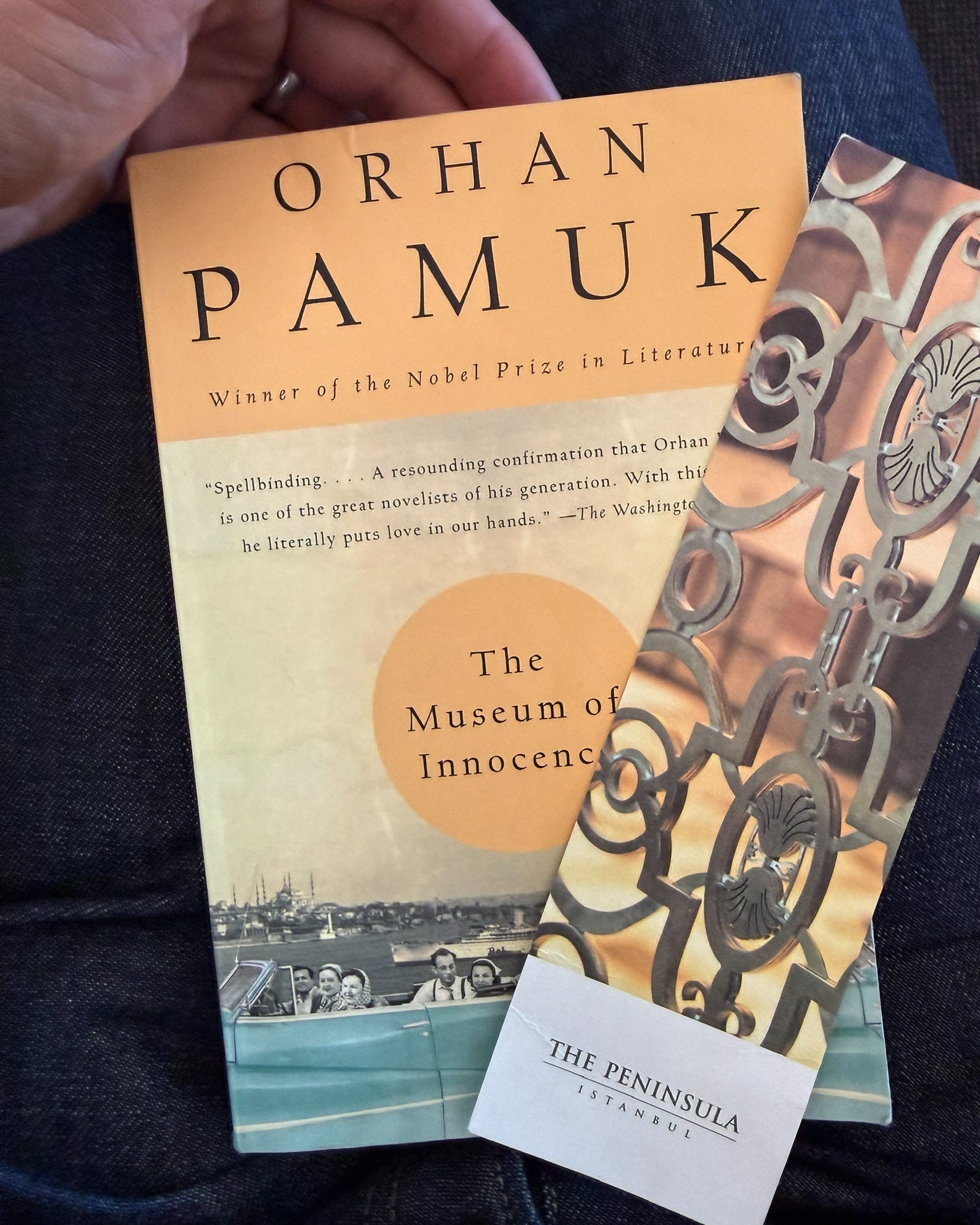
The Museum of Innocence was written by Orhan Pamuk, the only Turkish author ever to win the Nobel Prize. It’s set mostly in Istanbul, and my friend Laura chose it for us to read together ahead of and during our trip to Istanbul in April.
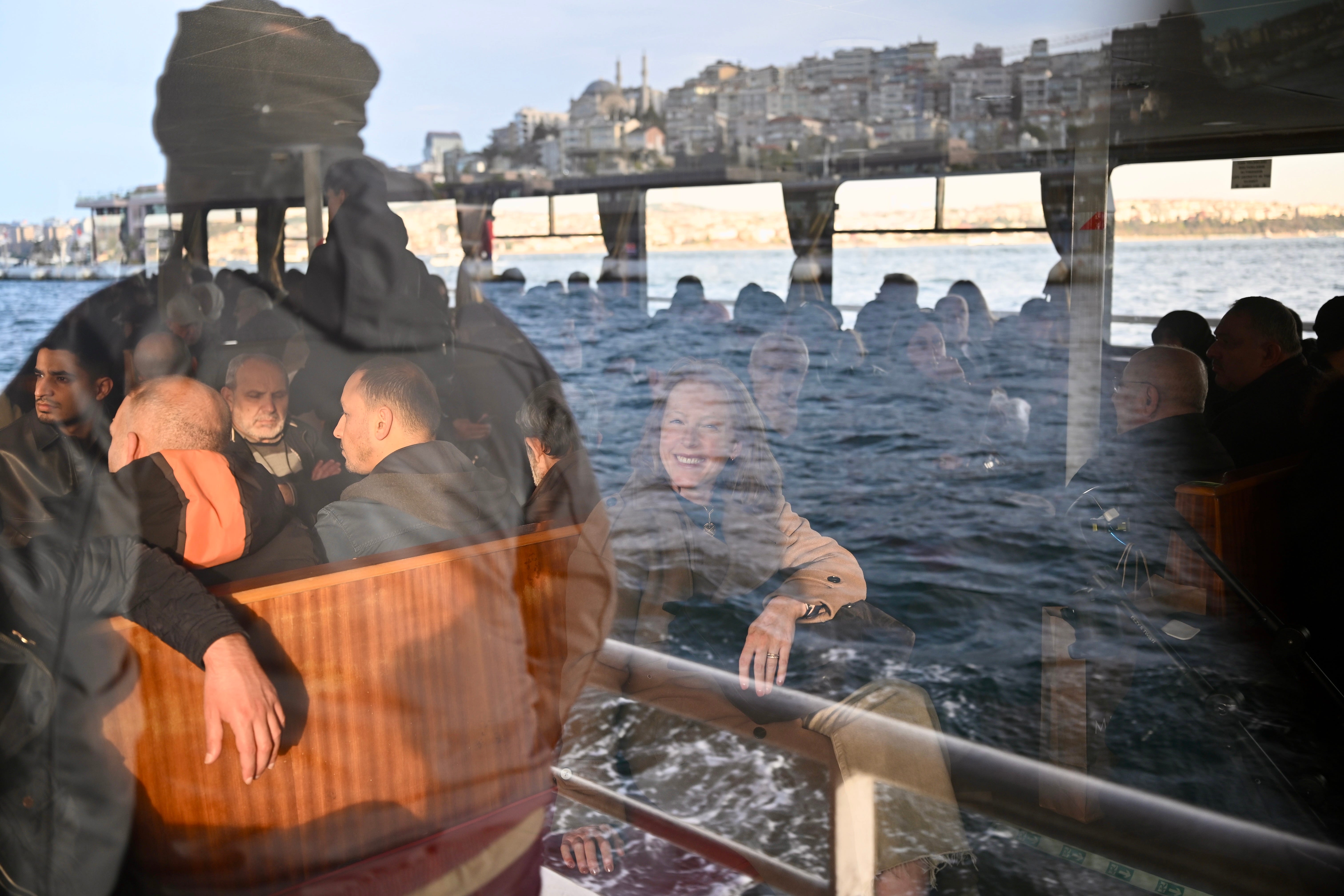
Years ago, I read My Name Is Red, perhaps Pamuk’s most acclaimed novel; I remember nothing about it, except that I found it boring. The Museum of Innocence was (mostly) not boring. Published in 2008, it chronicles the life of Kemal Basmacı, a scion of a wealthy industrialist family, and his impossible, irritating, at times obsessive love for Füsun Keskin, a younger, poorer distant relation. As the reader learns about Kemal’s inner turmoil to an excruciating degree, Pamuk depicts his country during decades of socioeconomic and political tumult. Turkish society and culture change. People struggle to adjust. Fortunes rise and fall; relationships and regimes blossom, then fade.
When Nedret, a concierge at our hotel, learned we were reading The Museum of Innocence, she immediately wrinkled her nose and said that she didn’t care for Pamuk’s writing. She didn’t want to say much more, beyond one simple fact: “I do not like his ideology.” As we talked more with Nedret and her colleagues, we learned that many Turkish readers object to how Pamuk portrays their country.
Pamuk depicts human longing—irrationality, passion, tenderness, perseverance—with rich complexity. His utterly unlikeable protagonist bewildered and at times infuriated me. It was altogether a lot, but I didn’t grasp Pamuk’s boundless commitment to his project until Laura and I visited the Istanbul museum he painstakingly created to bring his novel to life.
Throughout the book, Kemal pilfers innumerable objects belonging to Füsun or discarded by Füsun. Treasures, trinkets, detritus: They’re now all on display, along with other relics from Kemal’s life and the handwritten pages of Pamuk’s manuscript. (As Laura and I wandered the museum, I found myself Googling, “Was Kemal Bey a real person?” He was not, except in Pamuk’s realized imagination.) Kemal’s admission that he surreptitiously retrieved and kept more than 4,000 cigarette butts from Füsun’s ashtrays disgusted me. Seeing those cigarette butts neatly pinned to a wall in the museum, complete with lipstick smears and documentation, was a “wow” moment.
During the trip, Laura and I talked some about the book, by which I mean I mostly whined about how it was making me feel. Later, I realized I’d enjoyed the conversations about Pamuk—with Laura, with Nedret—more than I enjoyed reading Pamuk. I didn’t like The Museum of Innocence, but I respected it.
--
One summer in my late teens, I bought a bootleg copy of James Joyce’s A Portrait of the Artist as a Young Man from a bookseller in Shenzhen, China. On the train back to Hong Kong, I started reading.
Once upon a time and a very good time it was there was a moocow coming down along the road and this moocow that was coming down along the road met a nicens little boy named baby tuckoo...
Back then, Hong Kong still had plenty of sweatshops. In the street markets, you could buy seconds from the factories. One of my favorite T shirts read, “OANDY POUSE.” (Should have been “Candy House.”) After reading a few pages of my new book, I shoved it into my backpack, convinced I’d bought the literary equivalent of a misprinted T shirt. What a scam.
Once upon a time and a very good time it was, I worked for an editor who venerated Joyce, adored Ulysses, and thought that any properly educated person should not only read Ulysses but also find it hilarious. I’ve never read Ulysses. But while writing for this editor, I visited the James Joyce House in Dublin. There, I learned that, during revisions, Joyce often reworked his text to be less clear and more difficult. My copy wasn’t misprinted; he was trying to disorient the reader. This annoyed me so much that I was inspired to read Portrait again.
This time, after enduring a few pages, I was somehow disarmed and drawn in. Sometimes Portrait still irked me, but by the end—it isn’t a long book—I decided I quite liked it. “Like” or “dislike” seemed secondary, though. The novel immersed me in a life and a world not my own—and it made me feel something, whether that was irritation or delight or maybe the delight of irritation. Have you ever considered how alive you can feel when you’re irritated?
I’m glad I read Portrait, and I’m glad I read The Museum of Innocence. Neither was particularly relatable. Both demanded work—patience, longsuffering, surrender of expectation, a willingness to be taken somewhere unfamiliar. Both books moved me.
--
Not long ago I asked a friend what he was reading. He mentioned that his book group was discussing a recently published nonfiction book. “It’s not saying anything that hasn’t been said before,” I said. “Absolutely not,” he said, but the people in his reading group needed to be affirmed in what they already knew and believed.
I kept thinking about that: They needed to be affirmed in what they already knew and believed. It brought to mind the questions and comments I’ve often heard about books, whether my own or others’: “But what are the clear takeaways?” “Why do I care?” “I couldn’t relate.” Or conversely and more affirmingly: “It’s like he read my mind.” “I felt less alone.” And “I felt like she was writing about me.”
None of these is inherently wrong. But they all leave me wondering whether we’ve come to want from books what we get from a Doordash order—quick satisfaction, effortless convenience, easy calories—or even the almighty algorithm—something tailored to my already evident tastes, relentless focus on the delivery of expected pleasure. If the main critique of a book is that it isn’t relatable, is that necessarily the author’s failure, or could it sometimes be the reader’s? Honestly, it might be a collaboration.
Look, I’m not immune to wanting what I want when I want it. Another dog video or ten? Yes, please. But this need to have one’s existing views affirmed, the emphasis on relatability, the centering of the self—these all demand examination. I wonder what’s behind the seemingly insatiable appetite for having one’s own views validated, one’s convictions and opinions and experiences and reactions reinforced. Surely something has happened to our relational muscles. Is this yet more evidence that empathy has atrophied, or were we always so weak?
I’ve participated in lectio divina Bible studies several times, and it has always struck me as odd that participants are often asked, “Where do you see yourself in the story?” I understand the attempt to ignite imagination or build relevance. But maybe we also risk inserting ourselves where we don’t need to be. Surely we can appreciate a story without being in it. It’s possible, even valuable, to bear witness to another’s experience, and to say, My goodness, this is how someone else has moved through this world.
Books and stories can be mirrors in which we see ourselves. (For all our talk of diversity, it turns out that many of us just adore reading about ourselves.) I think I prefer them as windows, through which we see another—another life, another worldview, another perspective, another way of being human. So many stories aren’t easy or fun, but they nourish by stretching, questioning, challenging, goading.
When I was coming up in journalism, I was taught to use the word “I” rarely, if at all, except, of course, in quotes. The stories I was assigned to write weren’t about me; I think I wrote one first-person essay in my entire first decade as a reporter. The stories I most like to read—and the stories that teach me the most, if I’m doing my part as a reader—aren’t about me either.
I’m currently reading the Japanese novelist Banana Yoshimoto’s novel Kitchen. It tells the story of a young woman named Mikage Sakurai. After her grandmother dies, Mikage finds solace and shelter with a young man named Yuichi and his mother, Eriko, a transgender nightclub owner.
Kitchen is wonderfully weird, and what I appreciate most about it is the way Yoshimoto transports me into intimate spaces to which I wouldn’t otherwise have access. I’m about two-thirds of the way through, and I have no idea where this book is going, yet somehow its pages are exactly where I want to be. Hanging out late at night in Yuichi and Eriko’s dimly lit Tokyo kitchen as Mikage makes a snack, I sense a strange and generous hospitality, one that reminds me: Sometimes the best, most special place for the reader is just off the page, invited simply to pay attention and to try to understand.
What have you read lately that has moved you? What have been the highlights and low points of your summer reading, and why? I’d love to know.
Where I’m Going: How we read is on my mind because, in a couple of weeks, I head to New Jersey, where I’ll be a visiting professor in Princeton University’s journalism program. I’ll be teaching a course called Reading and Writing about Religion.
I’m not sure how it will feel to be back at my alma mater. Undoubtedly it will stir up some memories—and particularly as I remember how hard college was, especially during those first couple of years, I hope I will be able to encounter my students with empathy and gentleness.
I became a journalist because of a visiting professor in that same program, Charlotte Grimes of the St. Louis Post-Dispatch. The only journalism class I’ve ever taken was hers, called “Politics and the Press,” in the fall of my sophomore year. Her markings and notes all over my drafts, all in bright red pen, at first shocked me; nobody had ever gone at my writing like that before. Slowly, over the course of that semester, I came to see the respect and affection they represented. She told me she believed I could do better. She was the first person who believed I could tell stories for a living.
Princeton’s journalism program has had classes about all kinds of subjects—immigration, race, science, place, economic upheaval, climate change, sports, trauma. But despite the importance and influence of religion in the life of the world, it has never had a course on religion reporting and writing.
My syllabus is mostly done. I’m planning to have the students read a wide range of work, including in-depth reporting on Christian nationalism, some excellent interviews that touch on spirituality, personal essays about belief (or lack thereof), and thoughtful pieces that illuminate religiosity outside the traditional precincts of religion (what are the chants and songs at a football game in England if not liturgy, and is not a Taylor Swift concert a spiritual experience for her fans?). But I still have room and time to make some changes. If you’ve read an excellent piece of writing that somehow sheds light on the manifestations of faith in the contemporary world, I’d love to hear about it.
What I’m Listening to: I’m in a sad-song season, and here’s one for those who, like me, find themselves betwixt and between. Earlier this year, I was watching How to Get to Heaven from Belfast, which was created by Derry Girls mastermind Lisa McGee, and I had to stop and rewind when I heard the song “I Don’t Want to Go to You,” co-written by Gary Lightbody of Snow Patrol and Iain Archer. It so perfectly captures the complicated reality of wanting to hide and also longing to be known, stepping out bravely and then running back to one’s cave—which is to say, life (for many of us anyway): “Don’t forgive me, I’ll forgive myself/ Don’t believe a word I say/ So when I tell you I don’t need you here/ It means lots of things, but also you should stay.”
Where to Find Me: The rest of this year will be focused largely on that Princeton class as well as on my seemingly endless PhD dissertating, so I have just a few preaching and speaking dates scheduled. Come say hello!
September 13, 11 a.m.: Princeton University Chapel, Princeton, N.J.
September 20, 10 a.m.: Crosspointe Church, Cary, N.C.
October 11, worship at 10 a.m. and 5 p.m., talk and Q&A at 6 p.m: St. Matthew’s Episcopal Church, Louisville, Ky.
November 1, 10 a.m.: First Presbyterian Church, Berkeley, Calif.
November 8, 10 a.m.: Crosspointe Church, Cary, N.C.
That’s all for this week, other than a quick hello from the zinnias in my garden plot. Today, for the first time ever, I saw a hummingbird sipping nectar from one of my blooms, but alas, it did not consent to a photo. May these blossoms be for you a reminder that, amidst the tumult of these times, there is still resilient beauty all around us.


With gratitude and in hope,
Jeff
I lead a ZOOM book group. We just read and discussed The Serviceberry. I am cheering for the gift economy and the buy nothing groups. Barbara Gose
“Sometimes the best, most special place for the reader is just off the page, invited simply to pay attention and to try to understand.”
I get trapped by my Insta algorithm often, and it’s been interesting to see others commenting on videos that start with an opposing viewpoint only to be reacted to by someone with a similar viewpoint to mine saying, “For a second, I thought my algorithm betrayed me.” It’s been bugging me, but I don’t think I knew why until reading this essay this morning.
I remember toward the end of college, I listened to a podcast where the guest, while on the topic of how to address racism, asked, “How white is your bookshelf?”
I was working on a small farm at the time and stopped in my tracks, probably mid-bunch of radishes. The answer was very white—maybe all white.
As I’m reading this many years later, I’m realizing that although my bookshelf is now more diverse, I’m still mostly seeking out books that somehow represent me or a story I can see myself in—stories that benefit me. I like to think of myself as a pretty empathetic person, but you’re right—I think often I go to books to have my own views reaffirmed.
That said, I really enjoyed Braiding Sweetgrass last year, and I remember feeling stretched by it because there were many places where I felt my beliefs being challenged by the author.
Thank you for writing this—I have no doubt I’ll be mulling it over for the rest of the day.